

Your baby fights the breast, or your four-year-old still cannot say “rabbit” clearly. You are wondering if a tongue tie is behind it.
A tongue tie means the band of tissue under the tongue is too tight, which limits how the tongue moves. The most common signs are trouble latching in babies, and unclear speech or picky eating in older kids. Not every tongue tie needs treatment. When it does affect feeding, speech, or oral health, a quick release usually helps.
At Kid Focus Dentistry in Wheat Ridge, Dr. Ngo, DDS, and Dr. Afsaneh Noori, DDS, assess tongue ties as part of a whole-child view. That means they look at feeding, speech, sleep, and airway together, not just the tissue under the tongue.
Key takeaways for parents
- A tongue tie affects roughly 1 to 11 percent of newborns, per the American Academy of Pediatrics.
- In babies, the clearest sign is trouble latching, clicking sounds, or feeding that never seems to end.
- In older kids, watch for unclear speech, picky eating, or a tongue that cannot reach the roof of the mouth.
- A tongue tie that causes no feeding or speech trouble often needs no treatment at all.
- If feeding or speech is affected, ask for an assessment. A release is a short, in-office procedure.
Tongue tie, explained in plain terms
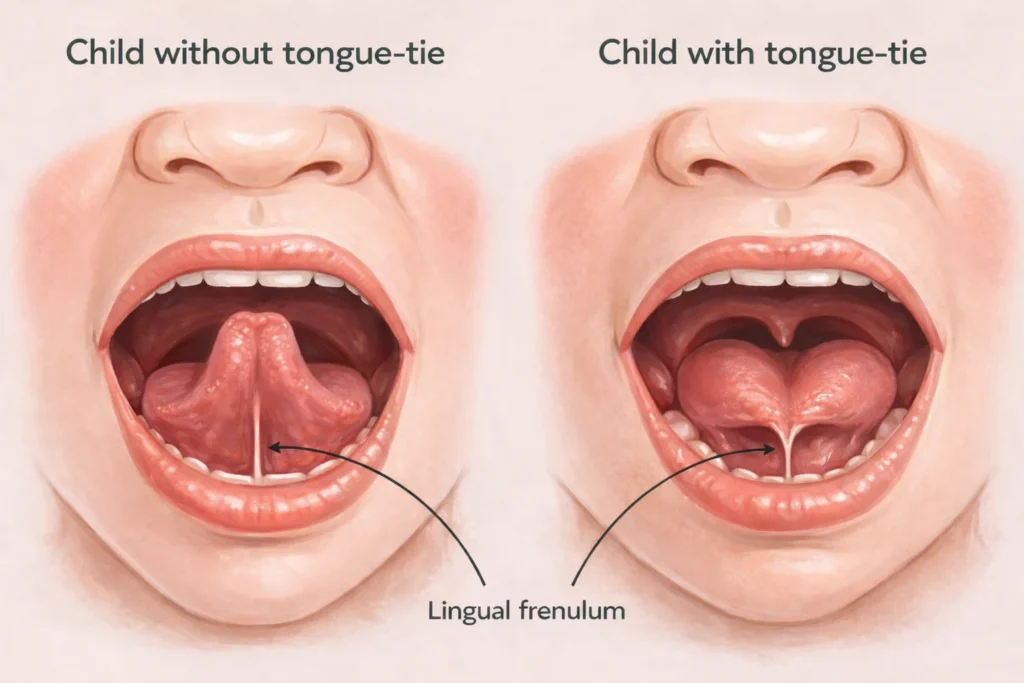
A tongue tie, called ankyloglossia, happens when the strip of tissue under the tongue is too short or too tight. This tissue is the lingual frenulum. When it is tight, the tongue cannot lift, stick out, or move side to side the way it should. You might first notice it when a baby struggles to feed or an older child struggles to speak.
The tongue does a lot of quiet work. It clears food off the teeth, shapes speech sounds, and helps a baby draw milk from the breast. When it cannot move freely, any of those jobs can suffer.
One visible clue is the shape of the tongue tip. When a tied tongue sticks out, the tip can pull into a heart or V shape. Children’s Hospital of Philadelphia lists this notched look as a common sign.
What are the signs in a baby?
In babies, tongue tie shows up at feeding time. A baby may fight to latch, slip off the nipple, or make a clicking sound while nursing. Feeds can run long, end in frustration, and start again soon after. Slow weight gain is the sign that matters most, and it means you should call your pediatrician.
Breastfeeding parents often feel the problem too. Children’s Hospital Los Angeles notes that a tight latch can cause sore or cracked nipples, low milk supply, and repeat bouts of mastitis.
Watch for these feeding signs in the first weeks:
- Trouble latching, or a latch that keeps breaking
- A clicking sound during feeds
- Feeds that last very long, then repeat quickly
- Fussiness and hunger that never seems to settle
- Slow weight gain, which needs a doctor’s review
Bottle-fed babies often feed fine, even with a tongue tie. Nemours KidsHealth points out that many newborns with a tie still bottle-feed well, so feeding trouble is a signal, not a certainty.
What are the signs in an older child?
In a child past infancy, tongue tie hides better. By toddler age, the clues shift from feeding to speech, eating, and mouth habits. A child might drop or slur sounds that need the tongue to lift, like l, r, t, d, n, and th. Picky eating and gagging on certain textures can also point to limited tongue movement.
Older ties are easy to miss because kids adapt. A child learns to work around the restriction, so parents and teachers often blame a speech delay on something else. Some ties sit further back on the frenulum and cannot be seen at all, which is why a trained assessment matters.
Signs to watch for in a toddler or school-age child:
- Unclear speech, especially on l, r, t, d, n, and th sounds
- A tongue that cannot reach the roof of the mouth or the back teeth
- Picky eating, gagging, or slow eating
- Trouble licking an ice cream cone or keeping food in the mouth
- Mouth breathing or noisy sleep, which can tie back to tongue posture
When treatment is needed, and when it is not
No tie needs treatment just for existing. A tongue tie only needs treatment when it causes a real problem with feeding, speech, or oral health. Many children have a slightly tight frenulum that never affects them. The Mayo Clinic and Nemours both note that plenty of ties cause no symptoms and need no procedure at all.
There is honest debate here. As awareness has grown, some experts worry that tongue ties are now over-diagnosed and released too often. A calm, unhurried assessment is the answer. The question is never “is there a tie,” but “is the tie actually causing this problem.”
This is where a whole-child assessment earns its keep. A good evaluation rules out other causes first. A baby’s latch trouble might come from positioning, a recessed jaw, or reflux, not a tie at all.
What happens if you wait?
Waiting is fine when the tie causes no trouble. Waiting is risky when it clearly affects feeding, speech, or sleep. An untreated tie that is causing symptoms does not usually fix itself, and the fallout can grow as a child grows. The cost of waiting depends entirely on whether the tie is doing harm.
For a baby who cannot feed well, the immediate risk is weight gain and nutrition. Feeding struggles can also cut a breastfeeding journey short before a parent is ready.
For an older child, a symptomatic tie can affect several areas over time:
- Speech: sounds needing tongue lift stay unclear, and some kids need longer speech therapy
- Oral health: a tongue that cannot sweep the teeth leaves more plaque, raising decay and gum risk
- Palate and bite: low tongue posture can shape a high, narrow palate and crowded teeth
- Sleep and airway: poor tongue posture is linked to mouth breathing and noisy sleep
None of this is a scare tactic. It is the reason a symptomatic tie is worth assessing early rather than watching it for years.
What the release procedure involves
A tongue tie release, called a frenectomy, frees the tight tissue so the tongue can move. In an infant or young child, it is a short in-office procedure, often done with a soft-tissue laser. The laser seals as it works, so bleeding and recovery time stay low. The whole thing usually takes only a few minutes.
Kid Focus Dentistry offers laser dentistry for this kind of soft-tissue work. Babies can often feed right after the procedure. Older kids usually return to normal eating and speaking within a day or two, with some stretching exercises to keep the area open as it heals.
Aftercare matters for a lasting result. Most providers ask parents to do gentle stretches for a couple of weeks so the tissue does not reattach. For speech-related ties, a few sessions with a speech therapist often round out the result.
What does a release cost, and does insurance help?
A laser tongue tie release in a dental office runs about $500 to $800 per tie in 2026. A scalpel release runs a bit less. Only complex cases done in a hospital under general anesthesia reach the higher four-figure range, and those are uncommon for a simple tie.
Coverage depends on why the release is done. When a tie stops a baby from feeding and gaining weight, medical insurance often treats it as a medical need, especially with documented feeding notes. Speech and dental cases may fall under dental coverage, sometimes partially.
Kid Focus Dentistry accepts Medicaid and CHP+, along with major dental plans, and offers CareCredit financing for families covering part of the cost. Bring your insurance card and any feeding or speech notes to the visit, and the team can check your coverage before anything is scheduled.
Getting your child assessed in Wheat Ridge
If your baby is struggling to feed or your older child’s speech worries you, an assessment is the clear next step. At our Pediatric Dentist in Wheat Ridge, serving families across Wheat Ridge and Arvada, Dr. Ngo and Dr. Noori evaluate tongue ties within a whole-child view that weighs feeding, speech, sleep, and airway together.
Kids who feel nervous can start with the Scarries pre-treatment program, which lowers dental fear before the visit. The team speaks English, Spanish, and Vietnamese, so you can ask every question in the language you know best. To book an assessment, call Kid Focus Dentistry at (303) 543-8338.